Jules & Jim Pedestrian and Bicycle Bridges
Mantes la Jolie – Limay |
France –
2026
Client
EPAMSA
Start of construction
12 | 2016
Size
202 m
Construction budget
4.6 M€
Competition winner
2012
Completion
09 | 2026
The Jules & Jim pedestrian and bicycle bridges reconnect the historic towns of Mantes-la-Jolie and Limay across the Seine, restoring a crossing interrupted since the destruction of the medieval bridge in 1940.
Commissioned by SMSO in partnership with the Île-de-France Region, the project forms part of a broader strategy to promote sustainable mobility while strengthening the relationship between the river, the surrounding landscape, and the historic urban centers.
Rather than reconstructing the former bridge, the project introduces two contemporary crossings that reinterpret the historic alignment while preserving the site’s exceptional cultural and natural heritage. Together, they create a continuous pedestrian and bicycle route linking public spaces, parks, and cultural landmarks across the Seine.
The architectural concept is defined by restraint and precision, with each bridge responding to its specific historical context.
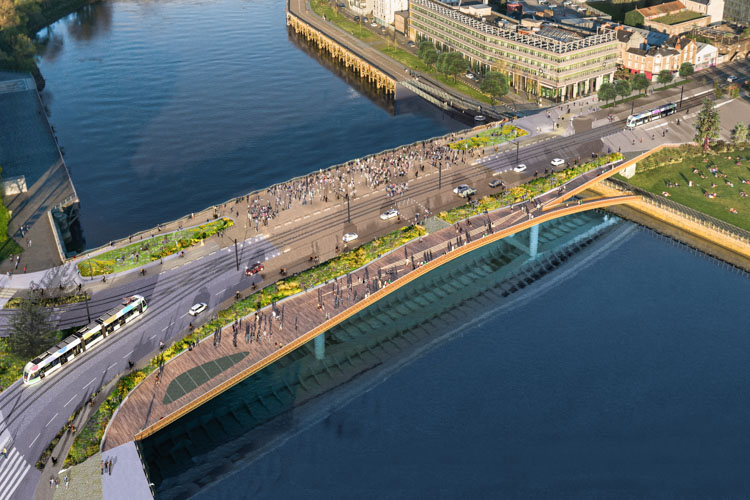
Jules, the 202-meter-long crossing between Mantes-la-Jolie and the Île aux Dames, is conceived as an independent contemporary structure. Its elegant steel arches shift away from the adjacent Pont Neuf, allowing the bridge to appear to glide above the river while preserving unobstructed views of the historic landscape. This first part of the project has been delivered in 2019.
The deck widens at key locations to form generous belvederes and resting areas, transforming the crossing into a public promenade that offers panoramic views of the Seine, the wooded island, and the skyline of Mantes.
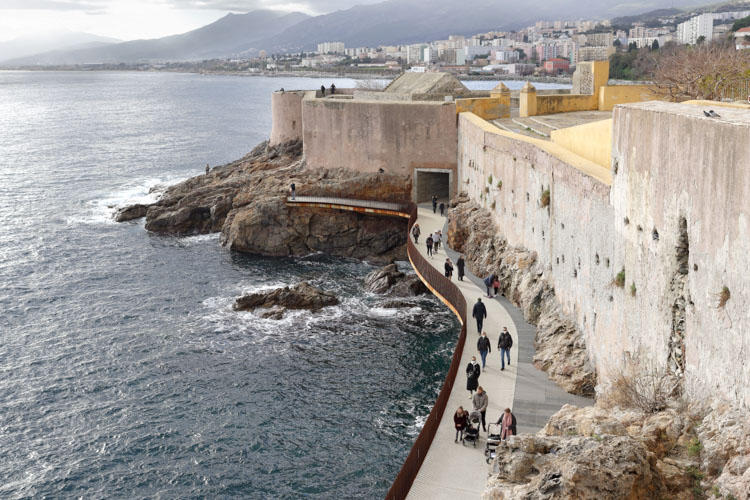
Jim, by contrast, spans the missing section of the medieval bridge between the Île aux Dames and Limay. Rather than reconstructing the lost masonry arches, it establishes a light and clearly contemporary connection between the surviving historic remains.
The intervention deliberately avoids imitation, preserving the legibility and authenticity of the protected monument while quietly restoring the continuity of a crossing that has shaped the Seine Valley for nearly a thousand years.
Although sharing a common architectural language of slender steel construction, the two bridges employ different structural principles.
Jules is based on a lightweight steel system composed of tapered trapezoidal box girders supporting cantilevered T-shaped brackets. Wherever possible, the deck is supported by the existing masonry piers of the eighteenth-century Pont Neuf, minimizing intervention within the riverbed and significantly reducing its environmental impact while accommodating the varying widths required for pedestrians, cyclists, and belvederes.
Jim, in contrast, is conceived as a minimal intervention within the medieval structure. Slender steel beams span between the preserved historic masonry, carrying a lightweight deck composed of steel, timber, and steel grating.
Stainless-steel mesh guardrails, integrated LED lighting, and carefully detailed connections reinforce the bridges’ lightness, durability, and transparency while ensuring long-term performance and low maintenance.
Beyond restoring a missing physical connection, the project reconnects a place of exceptional cultural significance.
The crossing occupies the site of the medieval bridge immortalized by Camille Corot and made famous through François Truffaut’s Jules et Jim.
By combining contemporary engineering with a careful respect for history, the project establishes a dialogue between heritage and innovation, creating resilient public infrastructure that reconnects not only two riverbanks, but also multiple layers of history, landscape, and everyday urban life.
Lead Architect: Dietmar Feichtinger Architectes, mandate
Construction: RAZEL-BEC – DRN IDF OUEST
Heritage architect: ALEP Architecture
Structural engineering: TERRELL
Hydraulic and environmental engineering: ANTEA GROUP
Lighting design: Coup d’éclat
Cost consultant: Dequaes
Scientific and technical control for the listed historic monument: DRAC Île-de-France
Photography: @Moritz Orgler
Commissioned by SMSO in partnership with the Île-de-France Region, the project forms part of a broader strategy to promote sustainable mobility while strengthening the relationship between the river, the surrounding landscape, and the historic urban centers.
Rather than reconstructing the former bridge, the project introduces two contemporary crossings that reinterpret the historic alignment while preserving the site’s exceptional cultural and natural heritage. Together, they create a continuous pedestrian and bicycle route linking public spaces, parks, and cultural landmarks across the Seine.
The architectural concept is defined by restraint and precision, with each bridge responding to its specific historical context.
Jules, the 202-meter-long crossing between Mantes-la-Jolie and the Île aux Dames, is conceived as an independent contemporary structure. Its elegant steel arches shift away from the adjacent Pont Neuf, allowing the bridge to appear to glide above the river while preserving unobstructed views of the historic landscape. This first part of the project has been delivered in 2019.
The deck widens at key locations to form generous belvederes and resting areas, transforming the crossing into a public promenade that offers panoramic views of the Seine, the wooded island, and the skyline of Mantes.
Jim, by contrast, spans the missing section of the medieval bridge between the Île aux Dames and Limay. Rather than reconstructing the lost masonry arches, it establishes a light and clearly contemporary connection between the surviving historic remains.
The intervention deliberately avoids imitation, preserving the legibility and authenticity of the protected monument while quietly restoring the continuity of a crossing that has shaped the Seine Valley for nearly a thousand years.
Although sharing a common architectural language of slender steel construction, the two bridges employ different structural principles.
Jules is based on a lightweight steel system composed of tapered trapezoidal box girders supporting cantilevered T-shaped brackets. Wherever possible, the deck is supported by the existing masonry piers of the eighteenth-century Pont Neuf, minimizing intervention within the riverbed and significantly reducing its environmental impact while accommodating the varying widths required for pedestrians, cyclists, and belvederes.
Jim, in contrast, is conceived as a minimal intervention within the medieval structure. Slender steel beams span between the preserved historic masonry, carrying a lightweight deck composed of steel, timber, and steel grating.
Stainless-steel mesh guardrails, integrated LED lighting, and carefully detailed connections reinforce the bridges’ lightness, durability, and transparency while ensuring long-term performance and low maintenance.
Beyond restoring a missing physical connection, the project reconnects a place of exceptional cultural significance.
The crossing occupies the site of the medieval bridge immortalized by Camille Corot and made famous through François Truffaut’s Jules et Jim.
By combining contemporary engineering with a careful respect for history, the project establishes a dialogue between heritage and innovation, creating resilient public infrastructure that reconnects not only two riverbanks, but also multiple layers of history, landscape, and everyday urban life.
Lead Architect: Dietmar Feichtinger Architectes, mandate
Construction: RAZEL-BEC – DRN IDF OUEST
Heritage architect: ALEP Architecture
Structural engineering: TERRELL
Hydraulic and environmental engineering: ANTEA GROUP
Lighting design: Coup d’éclat
Cost consultant: Dequaes
Scientific and technical control for the listed historic monument: DRAC Île-de-France
Photography: @Moritz Orgler